ARES MARKET

SECURITY & PRIVACY GUIDE

Comprehensive resources for anonymous marketplace access, operational security, and cryptocurrency privacy in 2025.

0 Resources
0 Guides
0 Security Rating

Understanding Anonymous Marketplace Security

In the evolving landscape of digital privacy, understanding fundamental security principles has become essential for anyone engaging with anonymous marketplaces. The intersection of cryptographic technologies, network anonymity, and operational security creates a complex but navigable environment for privacy-conscious individuals.

Anonymous marketplaces represent a sophisticated ecosystem where security isn't merely recommended — it's mandatory at every architectural layer. From encrypted communications to cryptocurrency privacy, from authentication systems to network-level anonymization, each component plays a critical role in protecting user identity and transaction security.

Organizations like the Electronic Frontier Foundation (EFF) and the Tor Project have established best practices for digital privacy that form the foundation of secure marketplace interactions. These principles, when properly implemented, create defense-in-depth security architecture.

This comprehensive guide explores the essential security technologies, privacy tools, and operational procedures necessary for safe engagement with anonymous platforms. Whether you're learning about Monero's privacy features, understanding PGP encryption, or configuring Tails OS, this resource provides actionable information based on established security standards.

Essential Security Topics

🔒

Tor Browser

Network anonymity through three-layer onion routing architecture for untraceable connections.

Learn More →
🔐

PGP Encryption

End-to-end message encryption using asymmetric cryptography for communication security.

Learn More →
💰

Cryptocurrency

Privacy-focused digital currencies for untraceable financial transactions on blockchain networks.

Learn More →
đŸ›Ąī¸

OPSEC

Operational security principles for maintaining anonymity through behavioral discipline.

Learn More →
✅

Secure Access

Verification methods for authentic marketplace connections and phishing protection.

Learn More →
📚

Resources

Authoritative security tools and privacy software from trusted open-source projects.

Learn More →

Latest Darknet & Security News

Recent developments in darknet markets, cryptocurrency privacy, and operational security for December 2025

Marketplace Dec 8, 2025

Monero Adoption Reaches 85% Across Darknet Markets

New research indicates that 85% of active darknet marketplaces now prioritize Monero (XMR) as their primary cryptocurrency, with many platforms discontinuing Bitcoin support entirely. The shift reflects growing concerns about blockchain analysis capabilities deployed by law enforcement agencies.

Major platforms including Ares Market have implemented Monero-only policies, citing transaction privacy as essential for user protection. Bitcoin mixing services report declining usage as users migrate to privacy-focused cryptocurrencies offering default anonymity features.

Security Dec 6, 2025

Tor Network Implements V4 Onion Address Protocol

The Tor Project announced deployment of version 4 onion addresses, extending address length to 62 characters and implementing quantum-resistant cryptography. The upgrade addresses potential vulnerabilities from advancing quantum computing capabilities while maintaining backward compatibility with v3 addresses.

Darknet marketplace administrators have six months to migrate services to v4 addresses. Security researchers note the quantum-resistant implementation provides protection against "harvest now, decrypt later" attacks targeting current cryptographic standards.

Cryptocurrency Dec 5, 2025

Monero Protocol Upgrade Enhances Privacy Features

Monero's December 2025 hard fork introduces enhanced ring signature algorithms and improved decoy selection mechanisms. The upgrade increases default ring size from 16 to 32, making transaction graph analysis significantly more computationally expensive.

Additionally, the update implements Seraphis transaction protocol improvements, reducing transaction sizes by 15% while strengthening privacy guarantees. Cryptocurrency exchanges supporting Monero report successful integration of the upgraded protocol.

Law Enforcement Dec 3, 2025

Operation Dark Chain Targets Cryptocurrency Mixers

International law enforcement coordination resulted in the seizure of three major Bitcoin mixing services, with authorities claiming the platforms facilitated over $2 billion in illicit transactions. The operation involved agencies from 15 countries executing simultaneous actions.

Privacy advocates express concern about targeting cryptocurrency privacy tools, arguing that mixing services serve legitimate purposes beyond criminal activity. The action highlights ongoing tensions between financial privacy rights and law enforcement objectives.

Technology Dec 1, 2025

Tails OS 6.0 Released With Enhanced Anonymity Features

The Tor-routed operating system Tails released version 6.0 featuring improved hardware compatibility, updated cryptographic libraries, and enhanced USB persistence encryption. The update addresses several security vulnerabilities while maintaining the platform's core privacy-preserving architecture.

New features include automatic Tor bridge configuration for censored networks and improved integration with Monero wallet software. The release continues Tails' position as the recommended operating system for darknet marketplace access.

Market Analysis Nov 29, 2025

Darknet Market Consolidation Continues in Q4 2025

Market analysis indicates ongoing consolidation within the darknet marketplace ecosystem, with three major platforms (Torzon, MGM Grand, and Ares Market) capturing approximately 70% of total transaction volume. Smaller niche markets struggle to compete against established platforms' vendor networks and security infrastructure.

Experts attribute consolidation to increased operational costs for maintaining secure infrastructure and users' preference for established platforms with proven track records. The trend mirrors broader e-commerce patterns toward dominant marketplace platforms.

Security Nov 27, 2025

PGP Key Length Recommendations Updated to 4096-bit Minimum

Security researchers recommend darknet marketplace users migrate to minimum 4096-bit PGP keys, with 8192-bit keys suggested for long-term communications. The guidance responds to advancing computational capabilities and anticipated cryptanalysis improvements.

Major marketplaces including Ares Market enforce 4096-bit minimum key requirements for vendor accounts, with plans to extend requirements to all users by Q1 2026. Legacy 2048-bit keys face deprecation across the ecosystem.

Cryptocurrency Nov 25, 2025

Monero Price Reaches $285 Amid Privacy Demand Surge

Monero (XMR) trading price reached $285 USD in November 2025, representing 180% year-over-year growth. Analysts attribute price appreciation to increased adoption across darknet marketplaces and growing institutional interest in privacy-preserving cryptocurrencies.

The price surge follows several exchange delistings in jurisdictions implementing strict cryptocurrency regulations, paradoxically increasing demand for privacy coins among users seeking financial autonomy. Trading volume concentrates on decentralized exchanges supporting Monero pairs.

Live Cryptocurrency Prices

Real-time market data for privacy-focused cryptocurrencies. Prices updated every 60 seconds from CoinGecko API.

Monero (XMR)

Privacy Coin
$Loading...
Loading...
24h Volume: $--
Updated: --:--

Bitcoin (BTC)

Accepted
$Loading...
Loading...
24h Volume: $--
Updated: --:--

Ethereum (ETH)

Reference
$Loading...
Loading...
24h Volume: $--
Updated: --:--

Data Source: Real-time prices from CoinGecko. Market prices may vary across exchanges. Always verify current rates before executing transactions.

Tor Network & Onion Routing Architecture

Understanding Tor Architecture

The Tor network implements three-layer onion routing to anonymize network traffic. When accessing an Ares marketplace or any onion service, your connection traverses three randomly selected relay nodes (entry guard, middle relay, exit/rendezvous node), with each layer encrypted separately.

Entry guards serve as your stable first hop, protecting against traffic confirmation attacks. The middle relay knows neither source nor destination, seeing only encrypted data passing through. For onion services specifically, the rendezvous protocol ensures that neither party learns the other's IP address — the server location remains hidden even from accessing users.

This architecture provides robust network-level anonymity, making it cryptographically infeasible to correlate incoming and outgoing traffic without compromising multiple nodes simultaneously. The Tor Project maintains this infrastructure with thousands of volunteer-operated relays worldwide.

For marketplace access, Tor's .onion addresses use 56-character v3 identifiers derived from public keys, enabling cryptographic verification of destination authenticity. This prevents DNS hijacking and man-in-the-middle attacks common with clearnet connections.

Tor Browser Configuration

Proper Tor Browser configuration is essential for maintaining anonymity when accessing official Ares marketplace mirrors or any darknet platform. Begin by downloading from the official Tor Project website — never use third-party mirrors or modified versions.

Set Security Level to "Safest" in Tor Browser settings. This disables JavaScript by default, prevents font fingerprinting, and blocks potentially dangerous content. While some marketplace features may require JavaScript, enabling it only for verified onion addresses reduces attack surface significantly.

Never maximize Tor Browser window — the specific window dimensions provide fingerprinting resistance by making all users appear identical. Avoid installing browser extensions, as these can leak identifying information or compromise connection security.

For maximum security, consider using Tor Browser within Tails OS or Whonix. Tails provides a live operating system that routes all connections through Tor and leaves no forensic traces on host hardware. Whonix isolates Tor networking in a separate virtual machine, preventing IP leaks even if the workstation VM is compromised.

PGP Encryption & Cryptographic Authentication

PGP Fundamentals

Pretty Good Privacy (PGP) provides end-to-end encryption for marketplace communications using asymmetric cryptography. In the Ares marketplace ecosystem, PGP isn't optional — it's mandatory for vendor communications, address transmission, and authentication.

PGP uses a key pair system: your public key (shared with vendors) encrypts incoming messages, while your private key (never shared) decrypts them. This mathematical relationship ensures that even if a marketplace server is compromised, intercepted messages remain unreadable without your private key.

Modern marketplace implementations typically require 4096-bit RSA keys minimum. Generate keys using GnuPG (GPG) or OpenPGP-compliant software. Never generate keys on shared computers or upload private keys to any website — these keys represent your cryptographic identity within anonymous marketplaces.

PGP signatures provide authentication: official Ares marketplace mirrors sign their onion addresses and announcements with a published public key. Verifying these signatures before accessing links protects against phishing sites that clone marketplace interfaces to steal credentials and cryptocurrency.

Key Management & Verification

Effective PGP key management is critical for long-term marketplace security. Store private keys on encrypted volumes, preferably on dedicated hardware security modules or air-gapped computers. Password-protect keys with strong passphrases unique to this purpose — key compromise allows decryption of all historical communications.

For Ares marketplace access, save the official platform PGP public key and verify all signed messages. Compare key fingerprints across multiple independent sources before trusting any key claiming to be official. Phishing operations frequently create fake keys with similar names.

When communicating with vendors, always verify their PGP fingerprint matches marketplace listings. Export and backup your public key to ensure consistent identity across sessions. Many marketplaces implement PGP-based two-factor authentication: logging in requires decrypting a challenge message, proving possession of the associated private key.

Consider using Tails OS with its integrated GnuPG configuration, which stores keys in encrypted persistent storage separate from the operating system. This provides compartmentalized key management ideal for marketplace operations.

Cryptocurrency Privacy & Transaction Security

Bitcoin Privacy Challenges

Bitcoin's transparent blockchain presents significant privacy challenges for marketplace transactions. Every transaction is permanently recorded with sender addresses, recipient addresses, amounts, and timestamps visible to all network participants. Blockchain analysis firms routinely trace Bitcoin flows across the network.

When using Bitcoin for Ares marketplace transactions, implement privacy-enhancing techniques. Use a dedicated wallet with no connection to exchanges requiring KYC verification. Generate new addresses for each transaction — address reuse creates linkable transaction history compromising anonymity.

Consider Wasabi Wallet or similar CoinJoin implementations that mix your transactions with others, breaking blockchain analysis heuristics. However, understand that Bitcoin privacy tools require technical proficiency and introduce additional operational risks.

More advanced users may implement multi-hop transaction routing through intermediary wallets, or exchange Bitcoin for Monero before marketplace deposits. However, the most effective approach remains using privacy-focused cryptocurrencies from the start, as recommended by most marketplace platforms including Ares.

Monero Privacy Features

Monero (XMR) implements privacy by default through three cryptographic technologies: ring signatures, stealth addresses, and RingCT (Ring Confidential Transactions). These features make Monero the preferred cryptocurrency for anonymous marketplace transactions, including those on Ares platform.

Ring signatures mix your transaction with decoys from the blockchain, making it cryptographically ambiguous which outputs are actually being spent. Stealth addresses ensure each transaction uses a unique, unlinkable destination address — even sending multiple payments to the same recipient creates no observable pattern on the blockchain.

RingCT hides transaction amounts, encrypting values so only sender and recipient know payment sizes. This prevents amount-based correlation attacks possible with Bitcoin's transparent transaction values. Together, these features provide strong default privacy without requiring user configuration or privacy-enhancing techniques.

For Ares marketplace transactions, acquire Monero through exchanges that don't require KYC, or trade from cryptocurrency ATMs. Download the official Monero wallet and maintain your own node for maximum privacy. Never share your private view key unless absolutely necessary — it allows transaction history decryption.

Password Security & Authentication

Strong password practices are fundamental to marketplace account security. Use genuinely random passwords of 20+ characters combining uppercase, lowercase, numbers, and symbols. Never reuse passwords across platforms — Ares marketplace credentials must be completely unique to prevent credential stuffing attacks if other services are breached.

Implement KeePassXC or similar offline password managers to generate and store complex credentials. Store the password database on encrypted volumes, protected by a strong master passphrase memorized and never written down. For maximum security, maintain marketplace passwords in a dedicated database separate from clearnet accounts.

Enable two-factor authentication (2FA) wherever offered by marketplace platforms. Many systems including Ares implement PGP-based 2FA, requiring you to decrypt a challenge message with your private key upon login. This cryptographic authentication is significantly stronger than SMS or TOTP codes, which can be intercepted or phished.

Consider using VeraCrypt encrypted containers to store password databases, PGP keys, and marketplace-related data. Hidden volumes within encrypted containers provide plausible deniability under coercion. Practice operational security by never accessing marketplace accounts from devices or networks that could be linked to your real identity.

Link Verification & Phishing Protection

Phishing represents one of the most significant security threats when accessing anonymous marketplaces like Ares. Fake sites clone authentic marketplace interfaces, stealing credentials and cryptocurrency from unsuspecting users. Implementing rigorous link verification protocols is essential before entering credentials or wallet addresses.

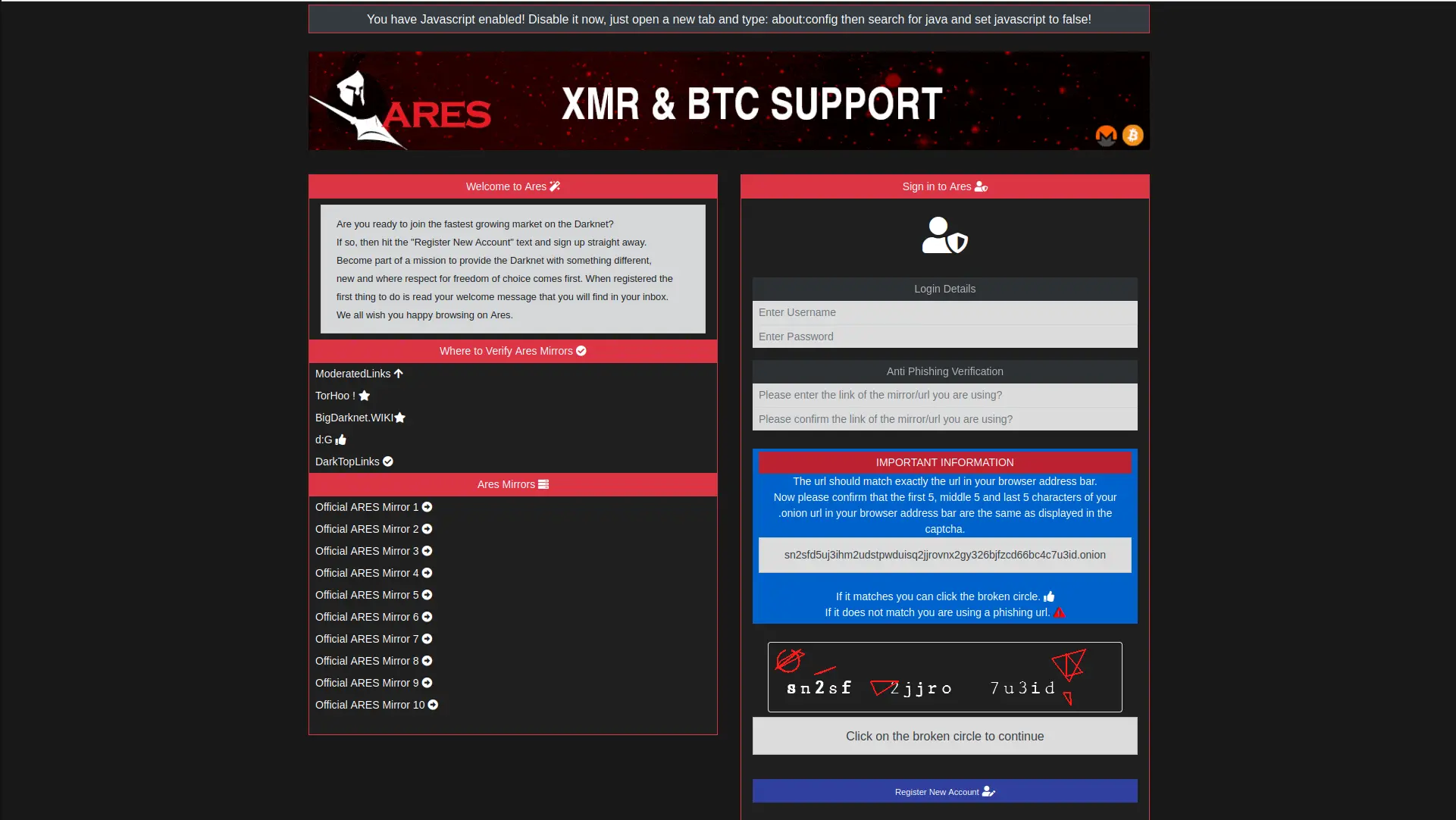
Official Ares marketplace mirrors use v3 onion addresses with 56-character identifiers. These addresses are cryptographic hashes of public keys, making them unforgeable — only holders of the corresponding private key can operate services at these addresses. Always verify complete onion URLs character-by-character against official sources before accessing.

Legitimate marketplace administrators sign official mirror announcements with PGP. Before trusting any link, verify the PGP signature matches the established official public key. Cross-reference onion addresses from multiple independent sources — forums, trusted directories, and direct communications from verified vendors.

Bookmark verified onion addresses in Tor Browser and access exclusively through bookmarks. If a marketplace suddenly requires re-entry of PGP private keys or seed phrases, this is a definitive phishing indicator — legitimate platforms never request private cryptographic material. When in doubt, contact known trusted vendors through previously established secure channels before proceeding.

Operational Security (OPSEC) Principles

Operational security encompasses the behavioral and procedural practices that maintain anonymity beyond technological protections. Even with perfect technical security, OPSEC failures can compromise your identity through correlation of activities, timing analysis, or linguistic fingerprinting.

Compartmentalization: Maintain strict separation between marketplace activities and regular online presence. Use dedicated hardware, separate cryptocurrency wallets, and distinct communication patterns. Never access marketplace accounts from networks associated with your identity, including home internet connections. Consider using public WiFi from locations without surveillance cameras, accessed through Tor Browser on Tails OS.

Need-to-Know Principle: Limit information disclosure to absolute minimum necessary. Avoid discussing marketplace activities on forums, social media, or with acquaintances. The more people who know about your activities, the greater the operational risk. Trust is a vulnerability — maintain strict confidentiality.

Assume Compromise: Operate under the assumption that marketplaces may be compromised, exit scam, or face law enforcement action. Never deposit more cryptocurrency than you're willing to lose. Withdraw funds promptly after transactions complete. Avoid finalize early (FE) arrangements unless working with established trusted vendors. Maintain healthy skepticism toward all marketplace communications.
Recommended Security Resources

Authoritative tools and information sources from trusted security organizations and privacy advocates.

Explore Ares Platform Information

🕒 Page last updated: